

This approach is increasingly important as the industry looks to improve recruitment and retention, and generate more meaningful trial outcomes. In this article, we explore what patient centricity really means in practice and examine practical ways organizations can embed patient-focused thinking into real-world clinical trials.
Contents
- Patient Centricity as a Design Principle in Clinical Trials
- Patient Centricity and Its Impact on Recruitment, Retention, and Representativeness
- Regulatory Expectations Shaping Patient-Centric Clinical Trials
- Implementing Patient-Centric Strategies in Clinical Trials
- Key Challenges in Delivering Patient-Centric Clinical Trials
- Real-World Applications of Patient-Centric Clinical Research
Patient Centricity as a Design Principle in Clinical Trials
Patient centricity in clinical research describes the intentional design of studies around patient needs, preferences, and lived circumstances. Rather than requiring participants to adapt to inflexible protocols, patient-centric trials seek to align study design, delivery, and communication with the realities of participation.
In practice, this involves more than engagement alone. It includes incorporating patient perspectives into protocol development, reducing avoidable burden, improving transparency, and designing trial experiences that support participation without compromising scientific rigor. Within this context, patient centricity is both a methodological and operational consideration: it can improve study accessibility while also strengthening the quality and relevance of the evidence generated.
Patient Centricity and Its Impact on Recruitment, Retention, and Representativeness
Patient centricity plays a key role in addressing some of the most persistent challenges pharma organizations face, including:
- Recruitment & Retention Challenges: Trials often struggle to enroll and keep participants due to heavy time commitments and burdensome procedures (such as frequent site visits or repetitive assessments). Patient-centric design reduces participant burden and aligns study logistics with real lives, improving enrollment and lowering dropout rates.
- Cost & Time Impact of Dropouts: Participant attrition increases study costs, reduces statistical power, and prolongs timelines. Better-aligned trial design supports more stable participation and reduces the risk of expensive delays and the need for extended recruitment.
- Diversity Shortfalls in Trial Populations: Underrepresentation of demographic groups limits the applicability and safety conclusions of trial results. Patient-focused approaches (e.g., flexible visits or culturally-appropriate materials) broaden access and improve representativeness.
- Outcomes & Efficiency: When patients are involved and supported, adherence improves, and the data collected is more complete and relevant. This leads to more reliable endpoints, faster decision-making, and better overall trial efficiency.
Regulatory Expectations Shaping Patient-Centric Clinical Trials
Regulatory expectations are playing an increasingly important role in driving patient-centric approaches in clinical trials. Regulators around the world are emphasizing the need to actively incorporate patient perspectives into trial design to improve transparency and outcomes. The most notable examples include:
The U.S. Food and Drug Administration (FDA)
The FDA has actively promoted patient-focused approaches through its Patient-Focused Drug Development (PFDD) program and related guidance activities, which are designed to systematically capture and incorporate patients’ experiences and perspectives into drug development and regulatory decision-making.
The European Medicines Agency (EMA)
The EMA operates a formal engagement framework for patients and consumers (updated in 2022), which has helped to define and use evidence-based patient-experience data in medicines development and regulatory assessment. This signals that patient perspectives are now considered across the product lifecycle.
Health Canada
Health Canada has similarly signaled a move toward greater patient input through public-engagement guidance, pilot projects to test patient involvement in regulatory review, and its Clinical Trials Modernization workstreams that consider decentralized models as part of updating Canada’s trial framework.
The Pharmaceuticals and Medical Devices Agency (PMDA)
Japan’s PMDA has established patient-centric working groups and published materials describing “Patient First” activities. This has helped organizations to incorporate patient voices into review processes and develop guidance and forums for patient participation.
Implementing Patient-Centric Strategies in Clinical Trials
So, what does patient centricity actually look like in terms of practical steps? Let’s take a deeper look at what you should do:
1. Involve Patients Early in Trial Design
Start involving patients as early as possible in trial planning and design, not just during recruitment. Including the people who will actually use the drug (and listening to their input on protocol features and language) ensures the study reflects real patient needs and improves engagement and adherence.
2. Create Tailored Strategies for Patient Groups
Recognize that one size doesn’t fit all; patients have diverse lifestyles and barriers. Tailored strategies can include flexible visit options, language-appropriate communication, and culturally-competent materials, helping accommodate different needs and improve the study’s overall participation.
3. Act on Patient Feedback
Collecting patient feedback isn’t enough on its own – organizations must act on it. When patients can see evidence of their advice being implemented, it acts as a great motivator for them to work with that entity again, benefiting the patients and the trial process as a whole.
4. Show Gratitude & Build Relationships
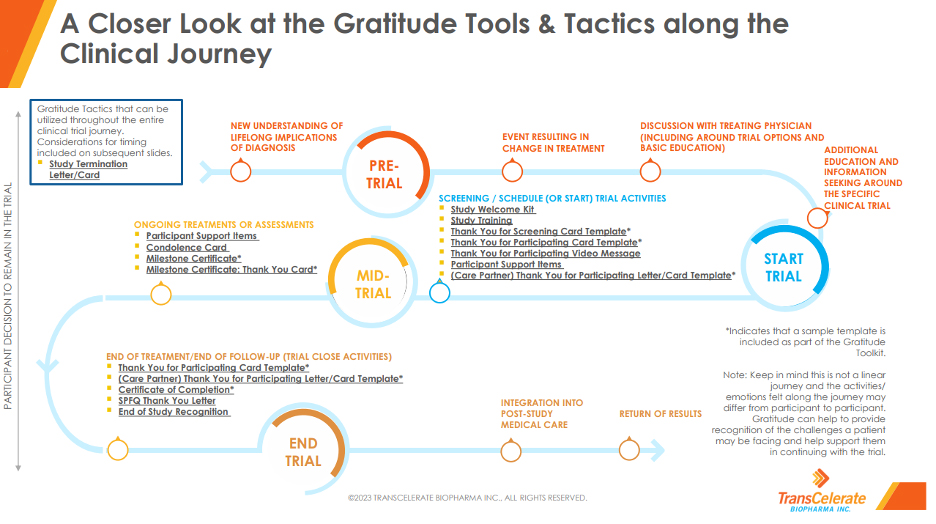
A 2022 study by TransCelerate BioPharma found that 1 in 3 clinical trial participants did not feel valued for their contribution to clinical trials. By showing genuine appreciation for patients’ time and contributions, sponsors can improve the overall participant experience and encourage engagement throughout the trial. Simple gestures of gratitude, like a thank-you message, help participants feel valued and more willing to stay involved throughout the study.
TransCelerate BioPharma has created a Gratitude Toolkit (GRAT) for use during clinical trials, which can be viewed below:
(Image source: https://myscrs.org/resources/showing-patients-gratitude)
Key Challenges in Delivering Patient-Centric Clinical Trials
Although patient-centric trials provide several benefits, some challenges persist. These include:
- Recruitment & Retention Difficulties: Strict eligibility criteria, time commitments, and participant burden make enrollment and ongoing engagement hard, increasing dropout rates and threatening study power.
- Logistical & Accessibility Barriers: Travel, appointment frequency, and mobility or caregiving constraints prevent many people from taking part, particularly those in rural or underserved areas.
- Poorly Designed Trial Protocols: Rigid visit schedules, invasive procedures, or unrealistic data-collection demands that don’t reflect patients’ lives drive disengagement and attrition.
- Limited Patient Involvement in Trial Design: When patients aren’t consulted early, studies can overlook real priorities and practical barriers, reducing relevance and uptake.
- Lack of Technology Access & Digital Literacy: Reliance on apps, wearables, or telehealth can exclude participants who lack devices, reliable internet, or the skills to use them.
- Privacy, Regulatory, & Ethical Concerns: Collecting patient-experience data and using digital tools raises issues around consent, data protection, and compliance that sponsors must manage carefully.
- Healthcare Inequality & Lack of Diversity: Socioeconomic, cultural, and language barriers lead to underrepresentation of key groups, limiting the generalizability and equity of trial results.
Working With Specialist Medical Linguists To Support Patient-Centric Trials
Patient-centric clinical trials rely on clear, accurate, and culturally appropriate communication at every stage of the research process. By working with specialist medical linguists, organizations can ensure patient-facing materials, study protocols, informed consent forms, and regulatory documentation are translated in ways that are both linguistically precise and culturally relevant.
At Conversis, we work exclusively with carefully selected specialist linguists who have extensive experience in life sciences and clinical research. Combined with our dedicated project management and rigorous quality assurance processes, this enables us to help sponsors communicate effectively with diverse patient populations while supporting recruitment, retention, regulatory compliance, and successful trial delivery.
Real-World Applications of Patient-Centric Clinical Research
Patient centricity becomes most meaningful when it is applied in practical, real-world ways that directly improve the patient experience. Here are just a few applications, based on our own experiences:
Through Technology
Digital tools and decentralized clinical trials (DCTs) let sponsors design studies that fit patients’ lives. For example, apps, telehealth visits, and home-based sampling reduce travel and time burden. When patients are involved early in technology choices, solutions become more intuitive, which supports enrollment, adherence, and data completeness.
Through Lay Summaries
Lay summaries translate complex trial aims and results into accessible information that patients can actually use. These summaries increase transparency and help participants understand their contribution and outcomes.
Through New Informational Content
Patient-informed resources, such as leaflets that participants give to employers to explain why they need to miss some work, help manage the wider impacts of participation. By addressing practical life needs and communication gaps, this content can reduce stress, remove barriers to participation, and support retention.
Supporting Patient-Centric Clinical Trials With Conversis
Delivering truly patient-centric clinical trials depends on more than well-designed protocols. Clear communication plays a vital role in helping participants understand what's expected of them, remain engaged throughout the study, and access information in a language they can trust.
Conversis supports sponsors, CROs, and life sciences organizations by managing specialist language services throughout the clinical research lifecycle. Working exclusively with experienced medical linguists, we help ensure patient-facing materials, informed consent documents, lay summaries, regulatory submissions, and other essential content are translated accurately and appropriately for global audiences.
If you're looking to strengthen patient engagement through high-quality medical translation, our team is here to help.


